
Overview
Achane is a proposed verification approach for radiation-shielding configurations. It is intended to establish certified response bounds across continuous ranges of material-composition and manufacturing uncertainty, including applications relevant to fusion systems.
The project begins with a straightforward engineering reality: a shielding design is analyzed using specified material properties, while the material that is actually produced may vary within permitted tolerances.
The problem
Radiation-shielding analysis often uses nominal material compositions. These nominal values provide a necessary reference, but manufactured materials are not perfectly identical to their design targets. Constituents may vary within specification, and the resulting response may not change uniformly.
For fusion systems, where high-energy neutron environments create difficult shielding and materials problems, confidence in the relationship between composition and performance can be especially important. An analysis performed only at the nominal composition does not, by itself, establish behavior everywhere within the allowed tolerance range.
The engineering question is therefore not only how the nominal design performs, but whether required response limits continue to hold throughout the set of material compositions that could legitimately be manufactured.
Geometry, source, and scoring definitions remain fixed. The verification question concerns every material composition permitted by the declared manufacturing or assay tolerances—not only the nominal recipe.
Proposed approach
Achane treats composition tolerance as part of the verification problem. The admissible material set is defined from the relevant specifications or uncertainty model, and the method seeks conservative bounds for selected shielding-response quantities over that set.
The output is intended to connect a declared range of material variation to an explicit statement about response. This may allow a reviewer to distinguish between nominal performance and performance that remains bounded across all compositions admitted by the model.
Achane does not assume that one material composition is worst for every response. Direction is certified separately, and unsupported behavior fails closed instead of being presented as a bound.
- Define admissible materials.Represent permitted composition and manufacturing variation as a continuous set.
- Evaluate the response range.Establish conservative bounds for the shielding quantities relevant to the decision.
- Support engineering review.Provide the bounds and assumptions in a form that can be examined independently.
Potential significance
If developed and validated, Achane could give shielding designers a clearer basis for deciding whether a configuration remains acceptable across real material tolerances. This could support design review, procurement specifications, quality assurance, and decisions about when additional margin or tighter material control is warranted.
The approach is not limited in principle to one reactor concept or shielding material. Fusion is a motivating application because of the field’s demanding neutron environment and its importance to Avila Labs, but the underlying verification question can arise anywhere shielding performance depends on uncertain material composition.
Current status
Achane is a patent-pending, early-stage research program. The current work defines the proposed verification framework. Further development would require implementation, benchmark problems, sensitivity analysis, comparison with established transport calculations, and review by specialists in radiation transport, shielding materials, uncertainty quantification, and fusion engineering.
Nothing on this page should be interpreted as a validated commercial capability, a certified shielding design, or evidence that a particular configuration satisfies a safety requirement.
Resources
A concise description of the material uncertainty model, verification objective, and proposed workflow.
ForthcomingInformation concerning the pending application and related technical disclosures.
Request accessQuestions, critique, and potential technical collaboration are welcome.
Contact Avila LabsTechnical figures
Figures from the patent-pending technical disclosure. They describe the proposed system, workflow, and illustrative cases; they are not validation results.
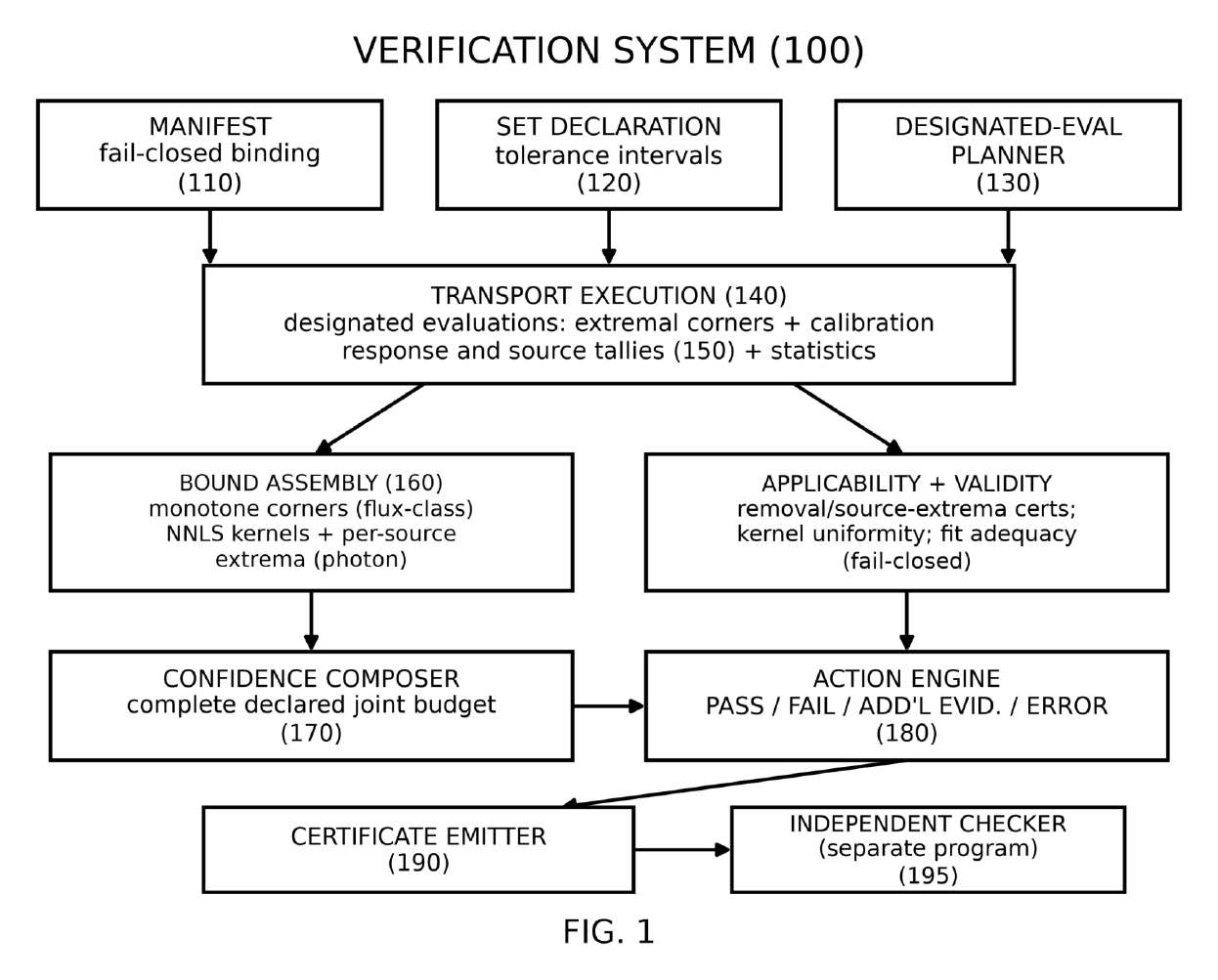
System architecture for declared tolerance intervals, designated transport evaluations, response-specific bound assembly, validity checks, actioning, certificate emission, and independent checking.
Full size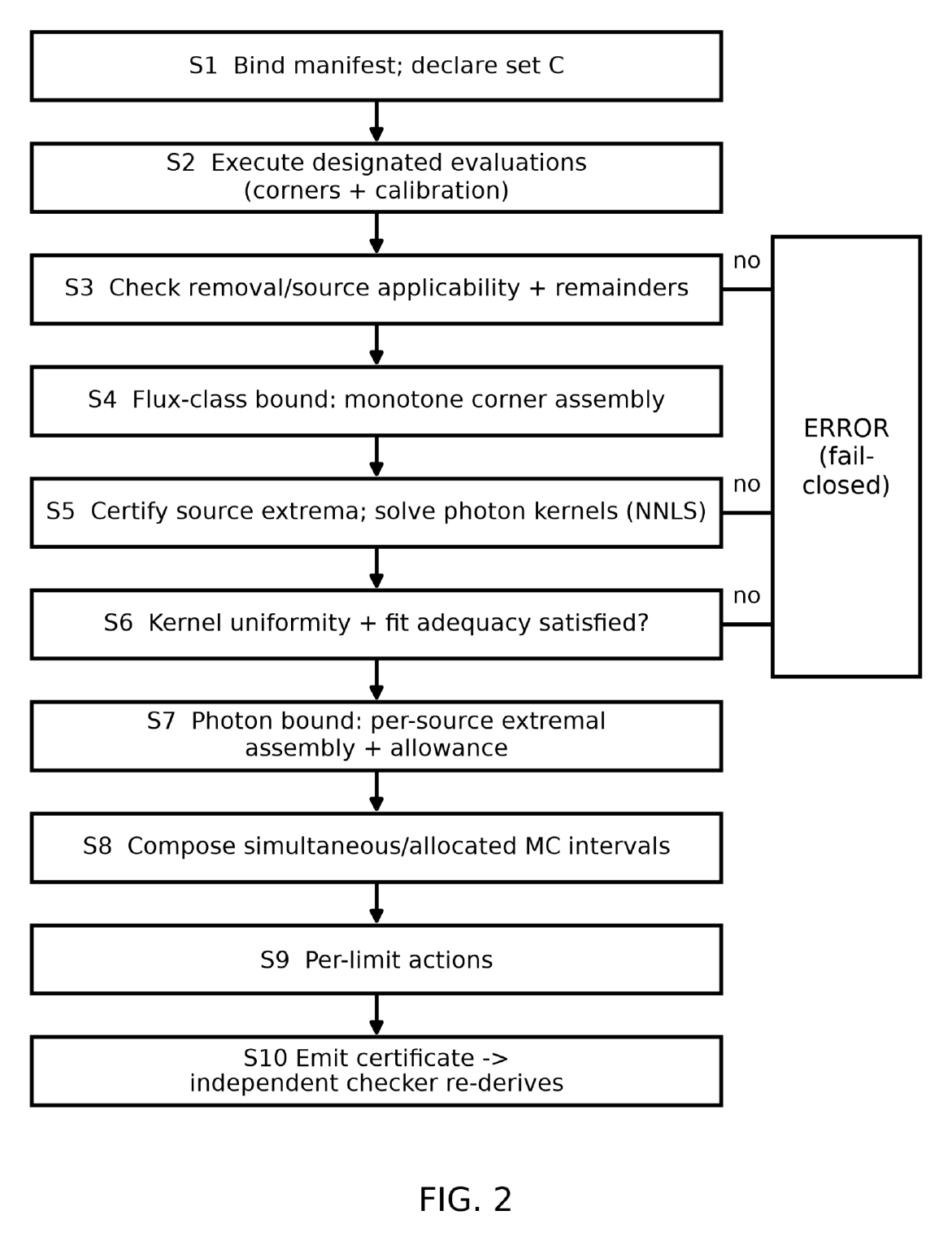
Fail-closed shielding-verification workflow from manifest binding and designated evaluations through flux-class and photon-bound assembly.
Full size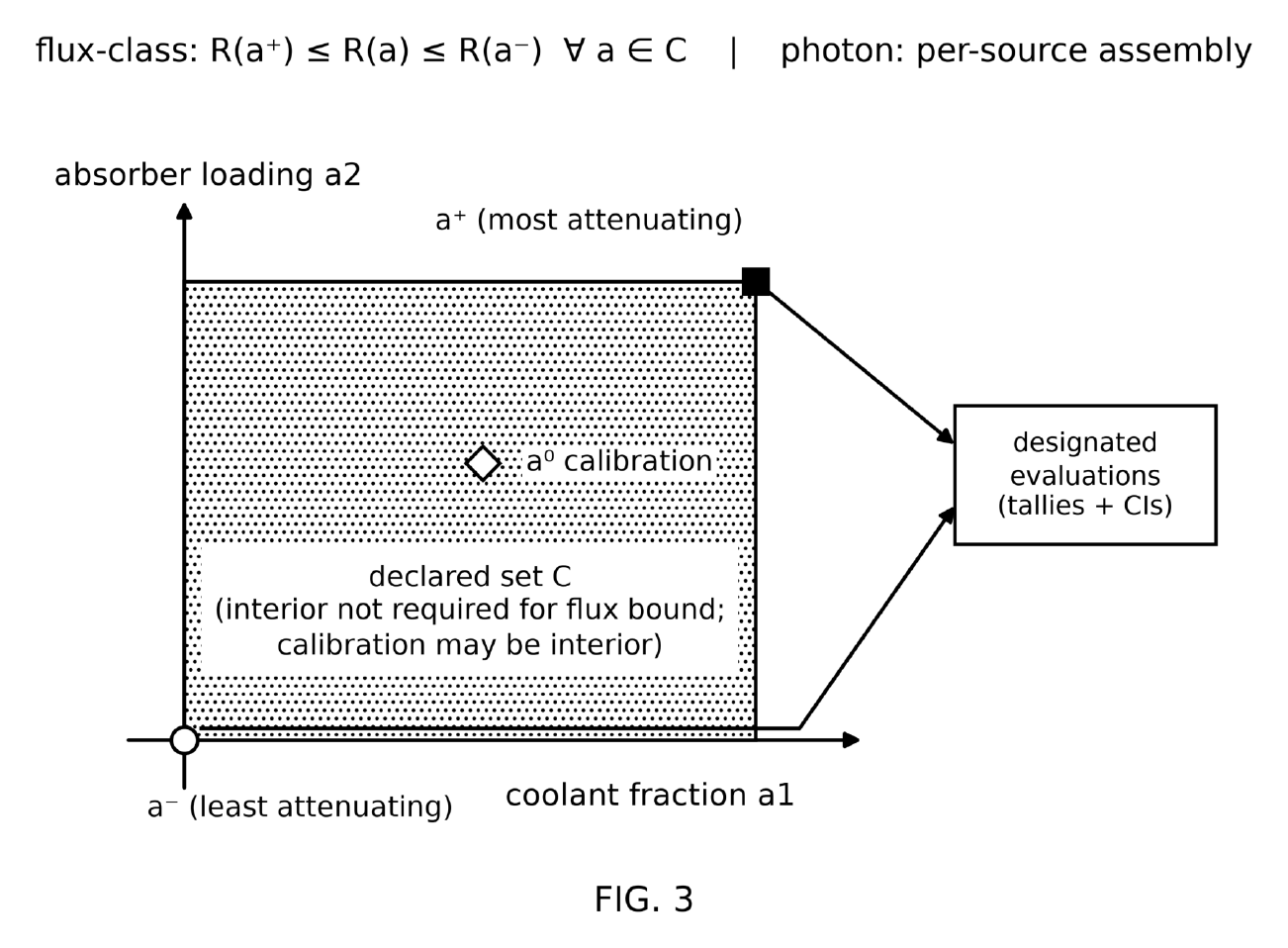
Continuous shielding-composition set with least- and most-attenuating corners and optional interior calibration evaluations.
Full size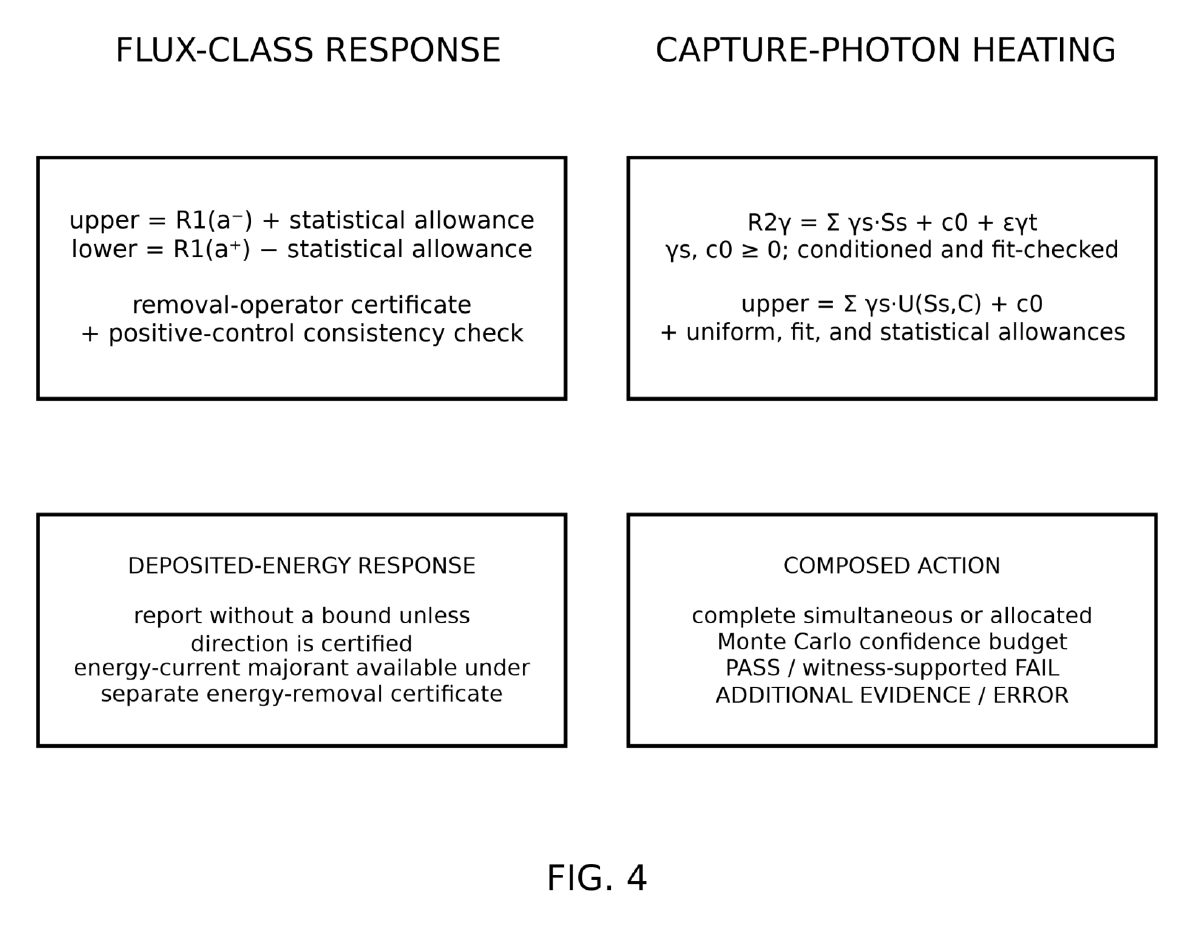
Response-specific construction for flux-class, capture-photon heating, and deposited-energy responses, followed by joint-confidence actioning.
Full size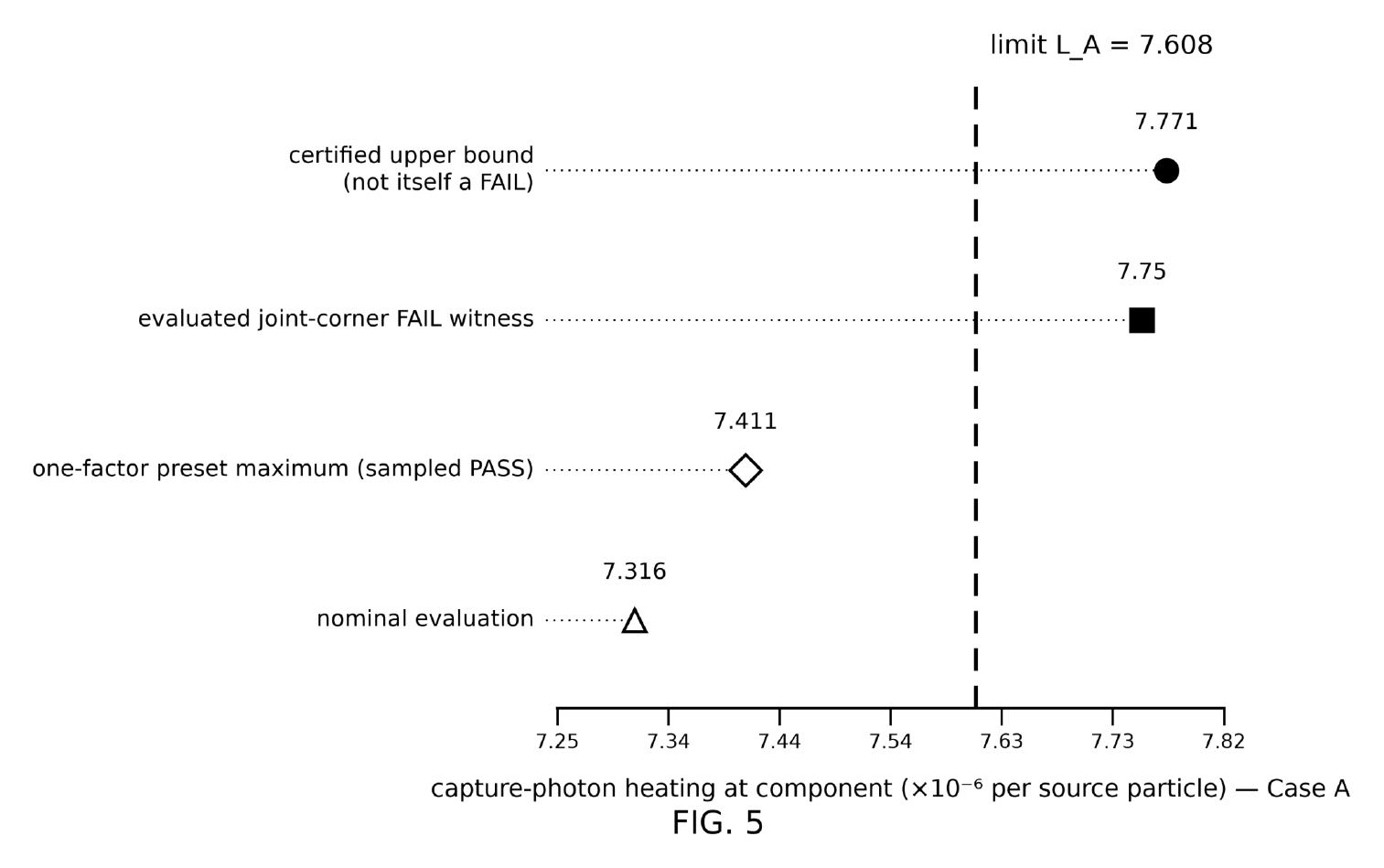
Illustrative heating case in which a joint-corner witness exceeds a limit although one-factor sampled values pass.
Full size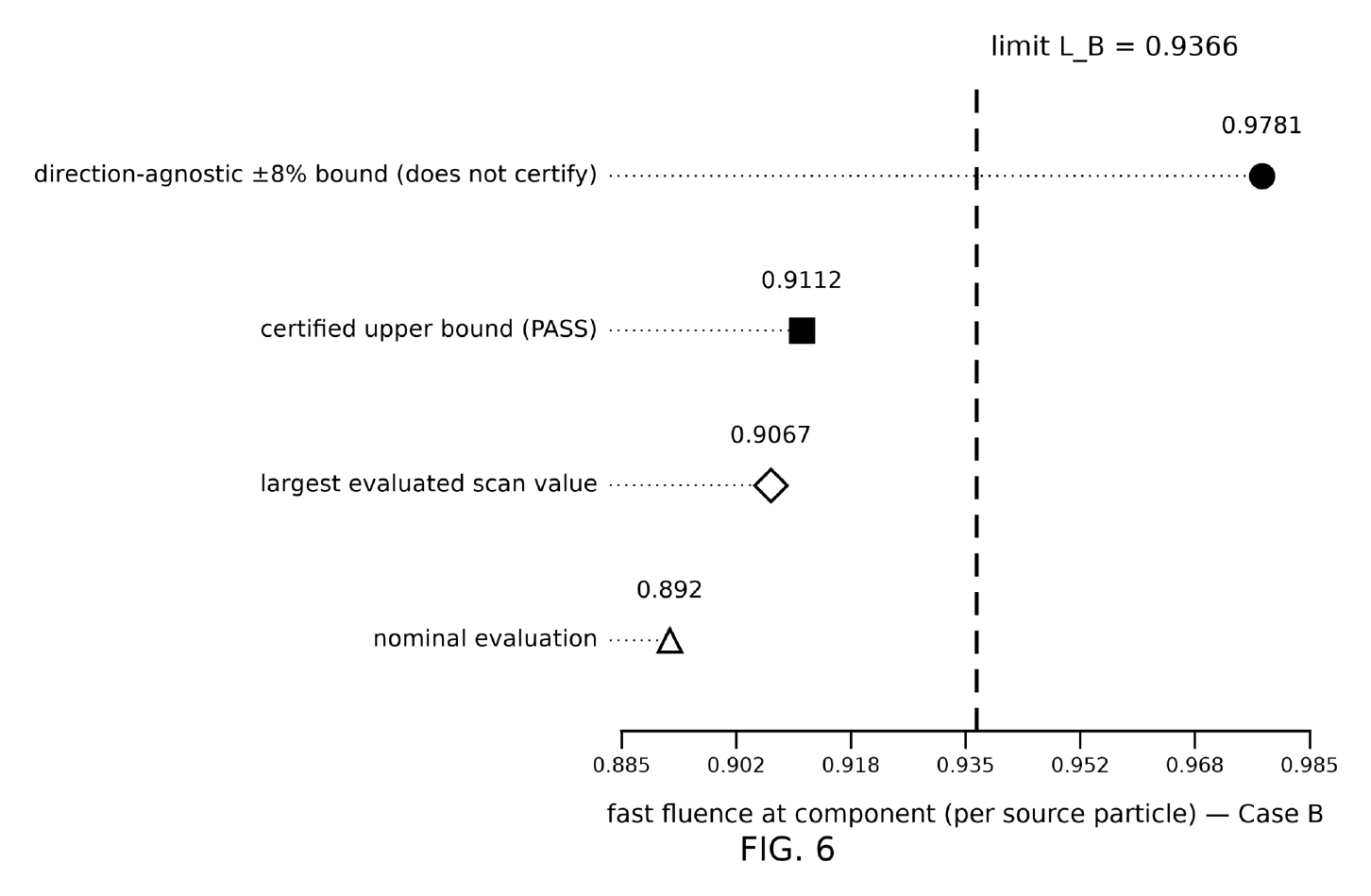
Illustrative case in which the certified upper bound remains below the limit and is tighter than a direction-agnostic allowance.
Full size