
Overview
Waddle is a proposed independent verification approach for boron neutron capture therapy treatment plans. Its purpose is to evaluate relevant dose quantities across a continuous set of plausible capture-agent distributions and produce certified bounds on the result.
The project addresses a quality-assurance question created by an essential feature of BNCT: treatment effectiveness depends in part on where the boron-containing capture agent is distributed, but that distribution cannot be known exactly throughout the patient.
The problem
BNCT aims to concentrate a neutron-capture agent in tumor tissue and then irradiate the treatment region with neutrons. Capture reactions produce high-linear-energy-transfer particles over a short range, making the spatial distribution of the agent central to dose estimation.
A treatment plan therefore rests on uncertain biological inputs. One way to explore uncertainty is to evaluate a finite collection of sampled scenarios. Sampling can be useful, but a finite set of points does not by itself establish what occurs everywhere inside a continuous range of admissible distributions.
The quality-assurance problem is to determine whether clinically relevant quantities remain within acceptable bounds for every distribution allowed by a stated uncertainty model—not only for scenarios that happened to be sampled.
The plan and neutron source remain fixed. What changes is the admissible capture-agent distribution—and therefore the response that quality assurance must bound.
Proposed approach
Waddle represents uncertainty in the capture-agent distribution as an admissible set rather than as a single nominal input. The verification process then seeks lower and upper bounds for specified dose quantities over the full set.
Conceptually, the workflow has three parts: define the permitted uncertainty, propagate that uncertainty through the relevant dose calculation, and produce conservative bounds together with evidence supporting the result. The intended role is supplementary and independent: it would check a plan rather than replace the treatment-planning system that generated it.
The dose components are not forced through one generic worst-case scenario. Each is bounded according to its certified direction or declared remainder, then recomposed by region of interest.
- Declare the uncertainty model.Specify the continuous range of capture-agent distributions considered plausible for the verification.
- Compute response bounds.Establish conservative lower and upper bounds for the quantities selected for review.
- Produce a checkable result.Return the bounds and supporting information in a form suitable for independent examination.
Potential significance
If the approach can be developed and validated, it could provide a more rigorous layer of quality assurance for BNCT planning under biological uncertainty. A dependable independent check may help researchers and clinical teams understand when a plan remains acceptable across a defined range of plausible conditions.
The broader potential is practical as well as technical. Quality-assurance burden can influence confidence, workflow complexity, and cost. Waddle is intended to investigate whether stronger verification can be made sufficiently clear and usable to support the field’s continued development.
Current status
Waddle is a patent-pending, early-stage research program. The present work defines the verification concept and its technical basis. Further development would require implementation, testing on representative planning problems, comparison with established methods, and collaboration with specialists in BNCT physics, dosimetry, treatment planning, and clinical quality assurance.
Nothing on this page should be interpreted as a claim of clinical validation, regulatory approval, or demonstrated improvement in patient outcomes.
Resources
A concise description of the uncertainty model, verification objective, and proposed workflow.
ForthcomingInformation concerning the pending application and related technical disclosures.
Request accessQuestions, critique, and potential technical collaboration are welcome.
Contact Avila LabsTechnical figures
Figures from the patent-pending technical disclosure. They describe the proposed system, workflow, and illustrative cases; they are not validation results.
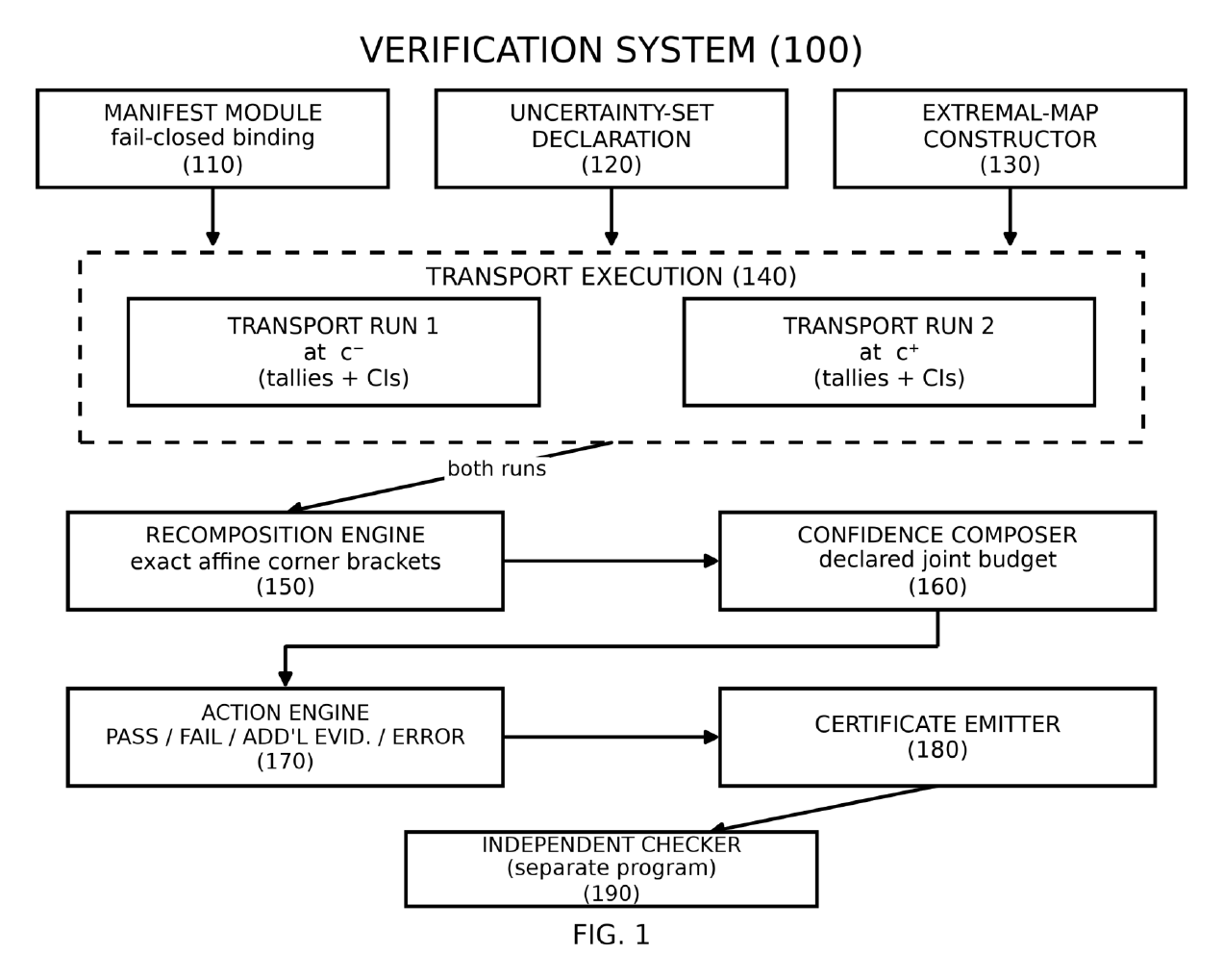
System architecture: manifest binding, uncertainty-set declaration, extremal-map construction, designated transport runs, affine recomposition, confidence composition, actioning, certificate emission, and independent checking.
Full size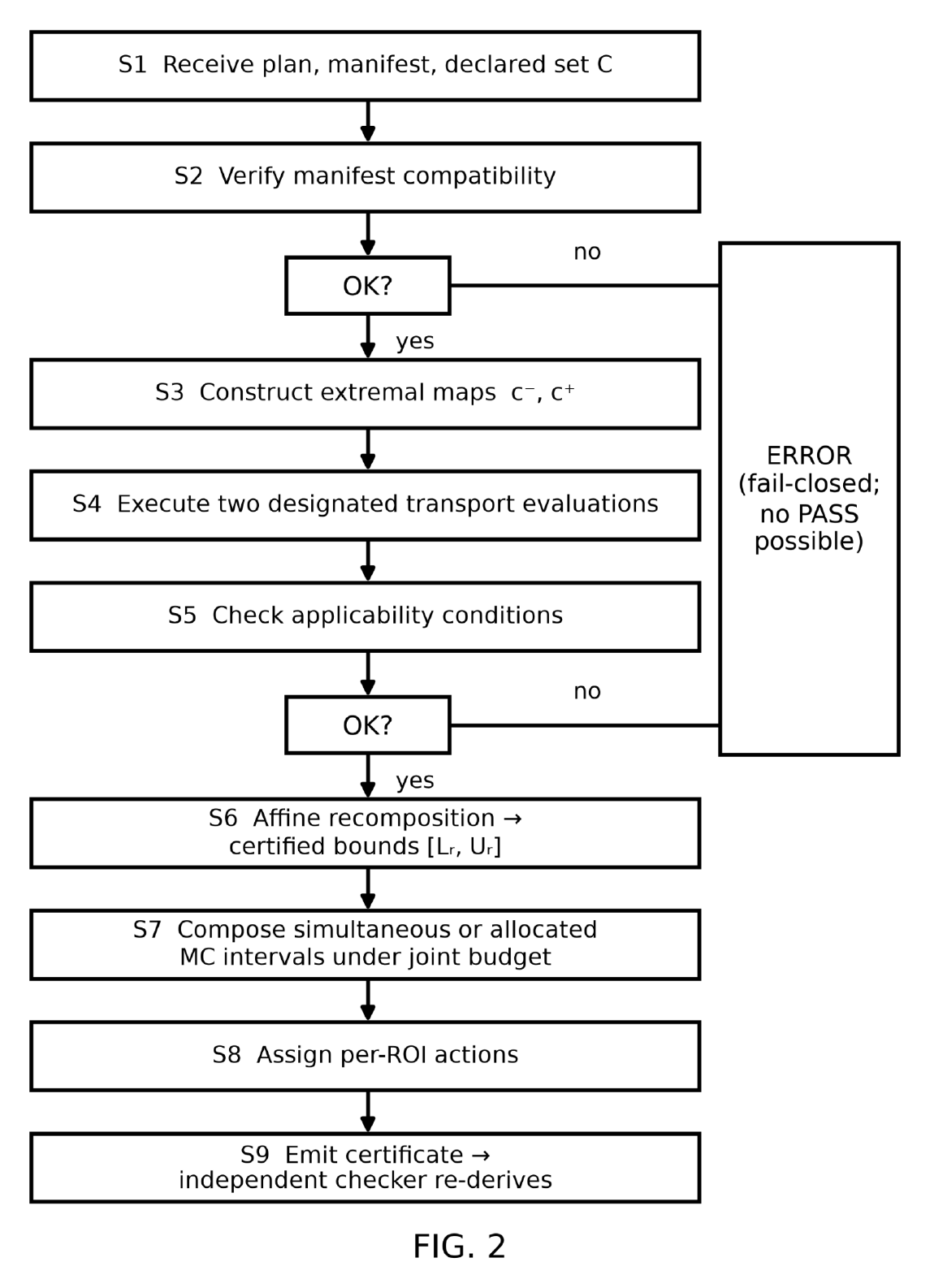
Fail-closed workflow from treatment-plan intake and manifest compatibility through extremal maps, transport evaluations, certified bounds, and independent checking.
Full size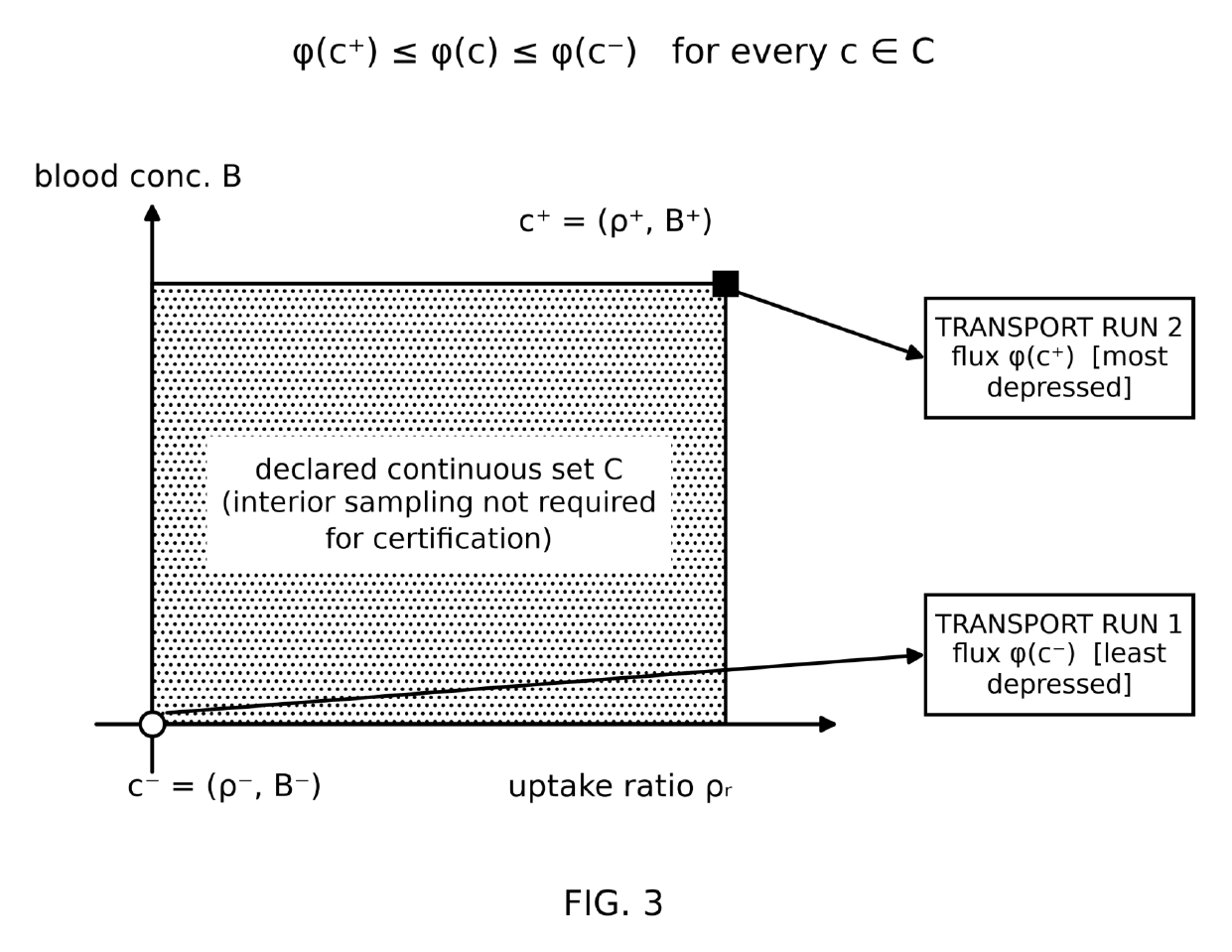
Continuous uncertainty set for uptake ratio and blood concentration, showing the two extremal evaluations used to bound flux behavior without requiring interior sampling for certification.
Full size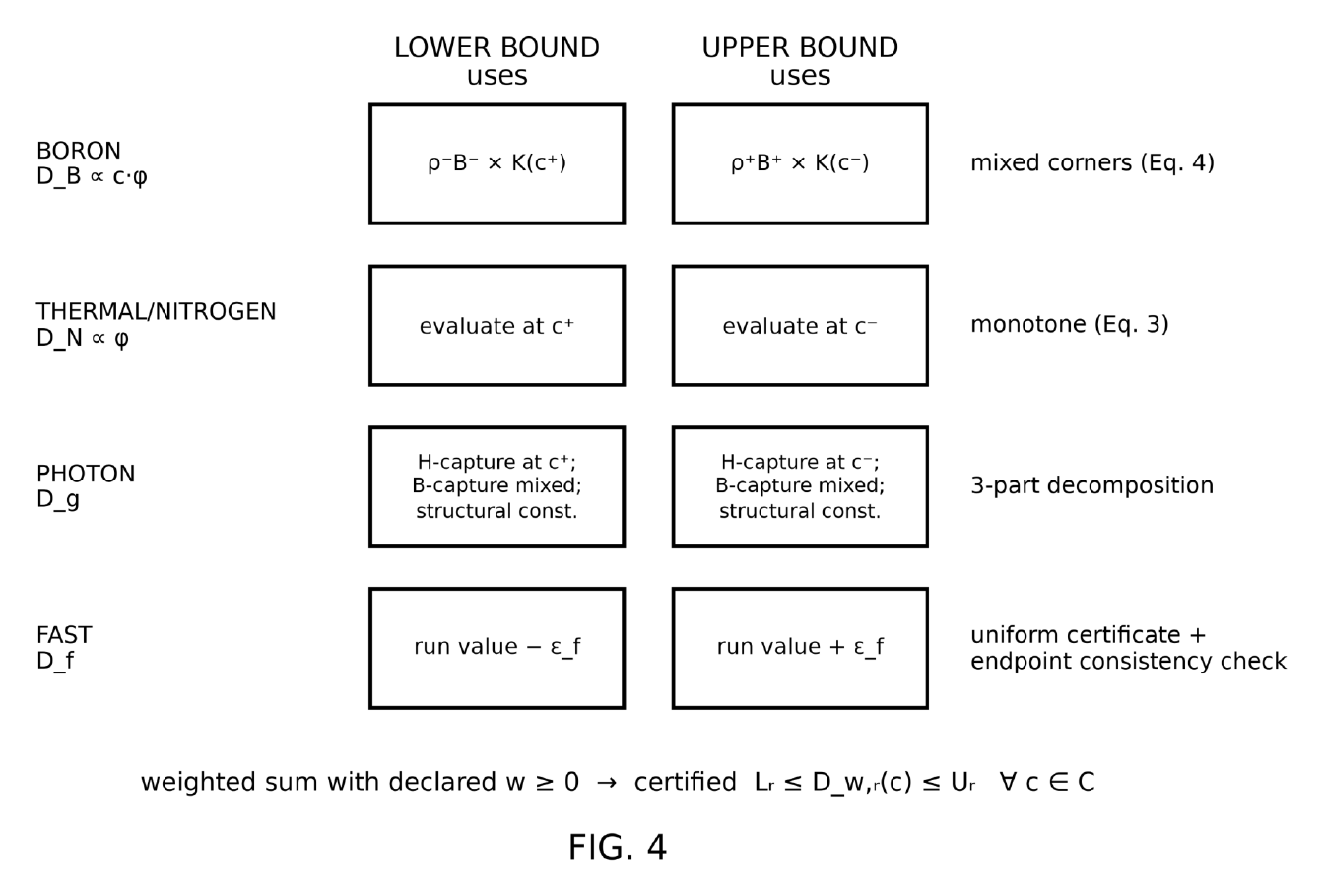
Dose-component recomposition: boron, thermal and nitrogen, photon, and fast-neutron terms use component-specific lower- and upper-bound constructions.
Full size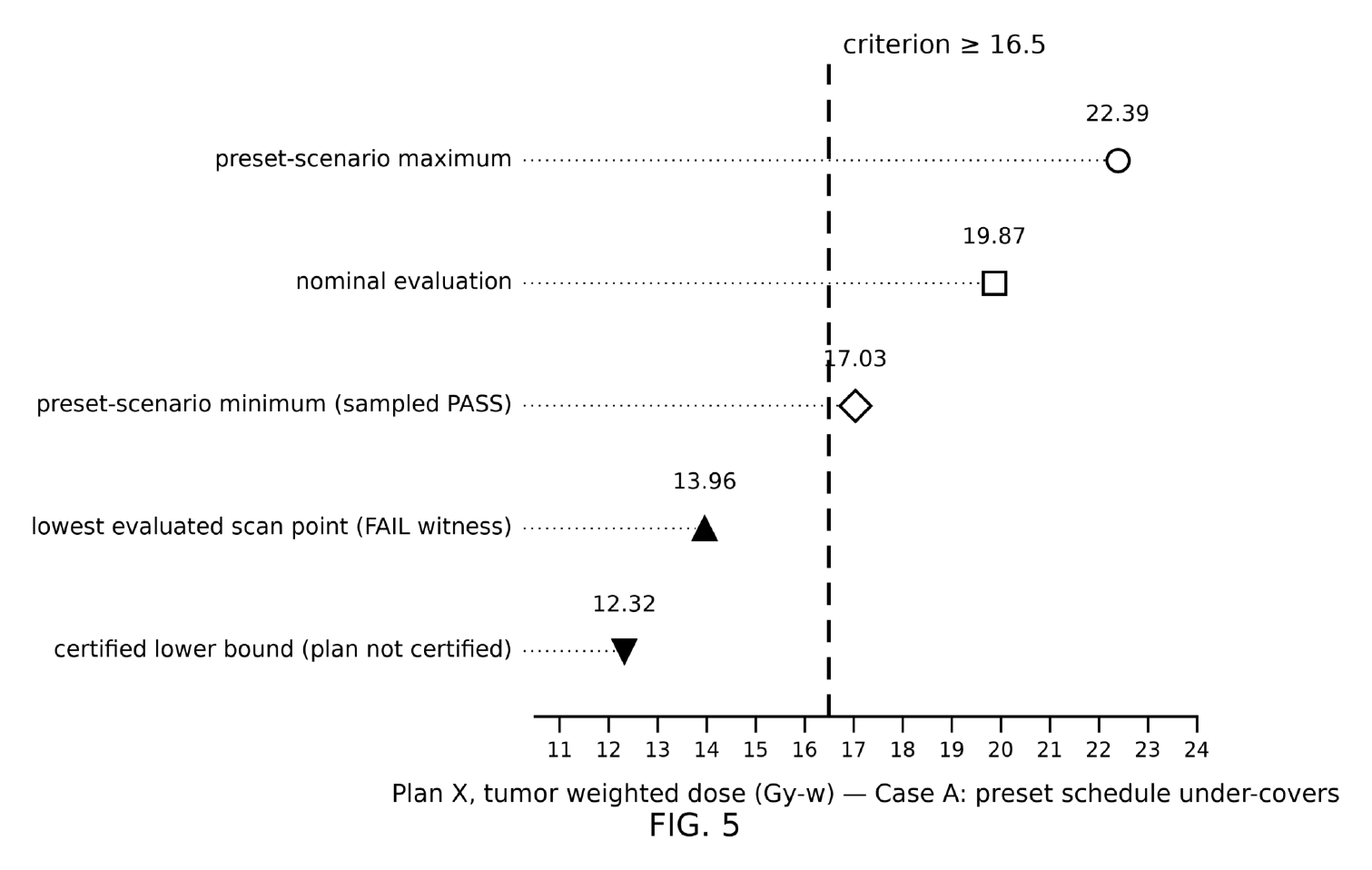
Illustrative tumor-dose case in which sampled presets appear acceptable while the certified lower bound does not establish coverage.
Full size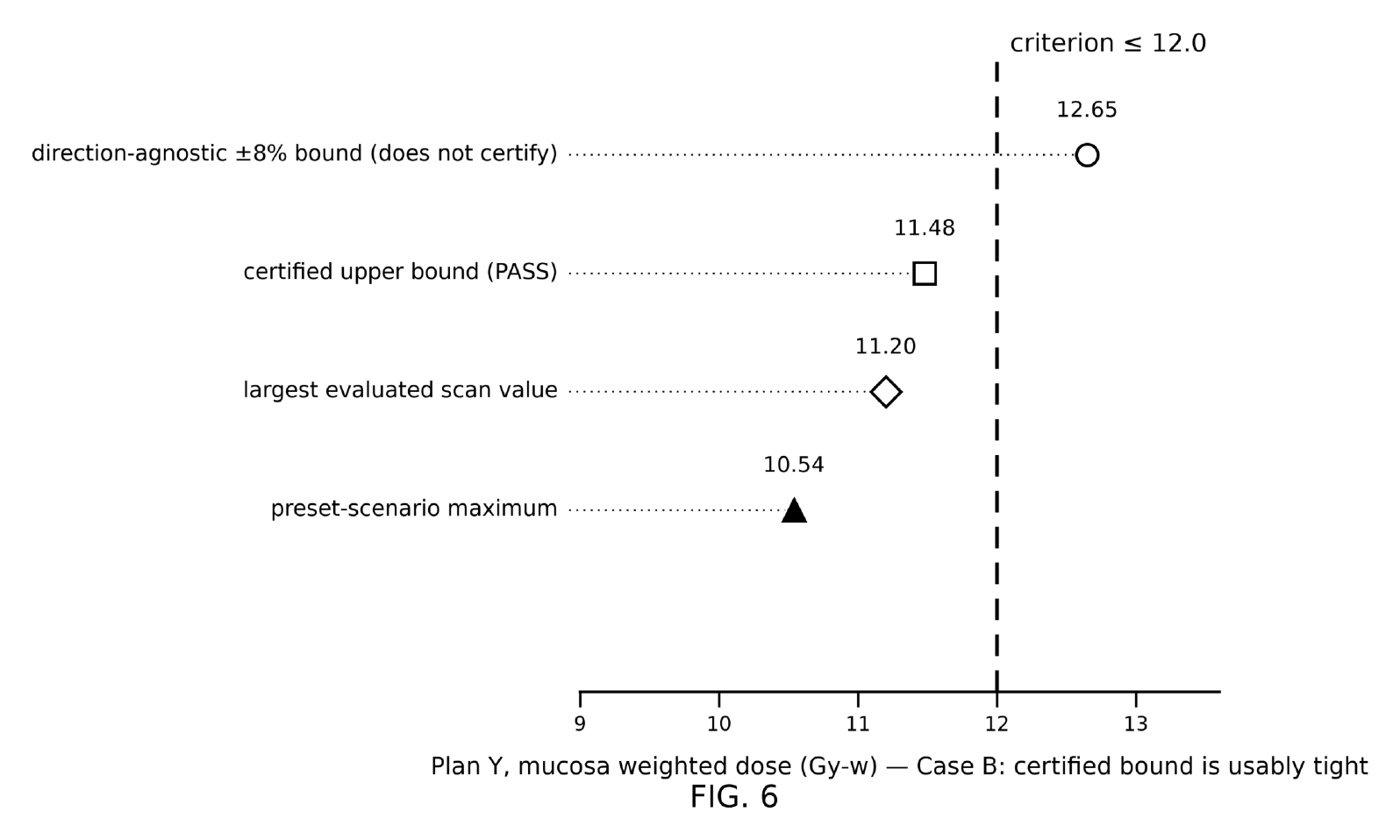
Illustrative mucosa-dose case in which the certified upper bound passes and is tighter than a direction-agnostic allowance.
Full size